




Stacked containers in the Port of Hamburg at blue hour
Microsoft SQL Server · from Hamburg for Germany, Austria and Switzerland · since 1994

From the foundation to the individual query.

We solve Microsoft SQL Server performance problems, plan and build highly available systems, and support enterprises, MSPs and data center operators, and software vendors in day-to-day operations.

Performance troubleshootingSQL Server Health ChecksAlways On Availability GroupsQuery StoreExecution plansWait statisticsFailover clustersExtended EventsEditions & coresIn-Memory OLTPIndexes & statisticsMigrationRelease comparisons
What this is about

Performance engineering and infrastructure expertise in one team. With our own tools, local and traceable.

Our day-to-day work

When SQL Server gets slow, we find the cause.

For many years we have been solving performance problems in SQL Server applications: in the interplay of application, queries, plans and platform. With experience from many environments and our own tools, which deliver evidence instead of guesswork.

More on SQL Server performance →
Performance engineer analyzing PSG QX on two monitors
Findings, not gut feelingQueries, plans, wait times and configuration in context
Testimonials

What our customers say.

“PSG has been helping us very successfully since early 2020 and enables our software developers to focus more on their creative tasks again. […] The technical level of the consulting impresses us again and again.”
Thomas WohllebenHead of IT, VdK EDV-Service GmbH
“Instead of generic best practices and piecemeal symptom fixes, they understood our development approach and the nature of our application systems and, starting from there, worked out concrete optimizations.”
Manuel SchliefHead of IT, PANTAENIUS Holding GmbH
“What impresses me about working with PSG, besides the exceptional, field-proven expertise, is above all the ability to get support at short notice.”
Sebastian MolchHead of Central Customer Service, Meierhofer AG
Services & tools

Der PSG Stack.

Five layers that build on one another. You engage the ones you need. We use our tools throughout so that every finding is verifiable.

Layer 01 · Foundation

Infrastructure & high availability

We plan and implement SQL Server infrastructures. We align architecture, edition and core count with availability, performance and cost-effectiveness. Because we don't sell licenses, we advise without a sales interest of our own.

  • ArchitectureAvailability Groups, failover clusters, disaster recovery
  • ImplementationBuild-out, migration, consolidation
  • Editions & coresfrom your perspective, not from a licensing perspective
More on infrastructure →
Layer 02 · Operations

Operations that think along with you

Ongoing SQL Server administration, owned jointly with your team, with a regular look at the state of your systems.

  • PSG DBA PoolBronze, Silver, Gold – from a single server to integration into your development
  • Co-managed operations 9x5Patches, backup & restore, security, clusters, documentation
  • System checksdaily or weekly, reachable on business days
More for operators →
Layer 03 · Performance engineering

Performance engineering

Our core: solving performance problems, urgently or in a targeted way, and continuously improving critical applications with PSG MX. Month by month as MX-Care, or in intensive phases as MX-Intensive.

  • Troubleshooting & analysishelp urgently, investigate in a targeted way, recommend by priority
  • PSG MXcontinuous performance engineering within the agreed scope
  • MX AIOpsour collection and analysis software, runs in your environment
More on performance →
Layer 04 · Evidence & analysis

PSG QX & QX Recorder

Evidence instead of guesswork. QX analyzes the execution history: which query, which plan, since when, and what actually changed after a modification. The Recorder captures the evidence of sporadic problems before it disappears.

  • PSG QXexecution history from the timeline through plans and statistics down to the line of code, comparisons before and after changes
  • QX Recorderif the problem occurs at night, the data is there in the morning
More on PSG QX →
Layer 05 · Product layer

QX Fleet

Performance knowledge across all installations of the same software. We show software vendors whether an anomaly affects the product, a group of environments or a single installation, and how a new release behaves in production.

  • Fleet analysisproduct-wide, environment-specific or a single case
  • Release assessmentbefore and after, across many installations
More for software vendors →
A look inside PSG QX

This is what evidence looks like.

How PSG QX thinks: Beneath the curve →
01 · Timeline

When did it get slow, and which plan was it?

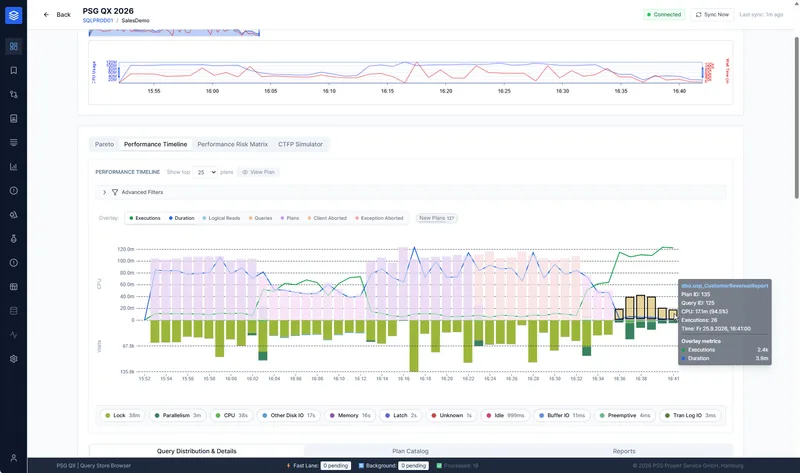
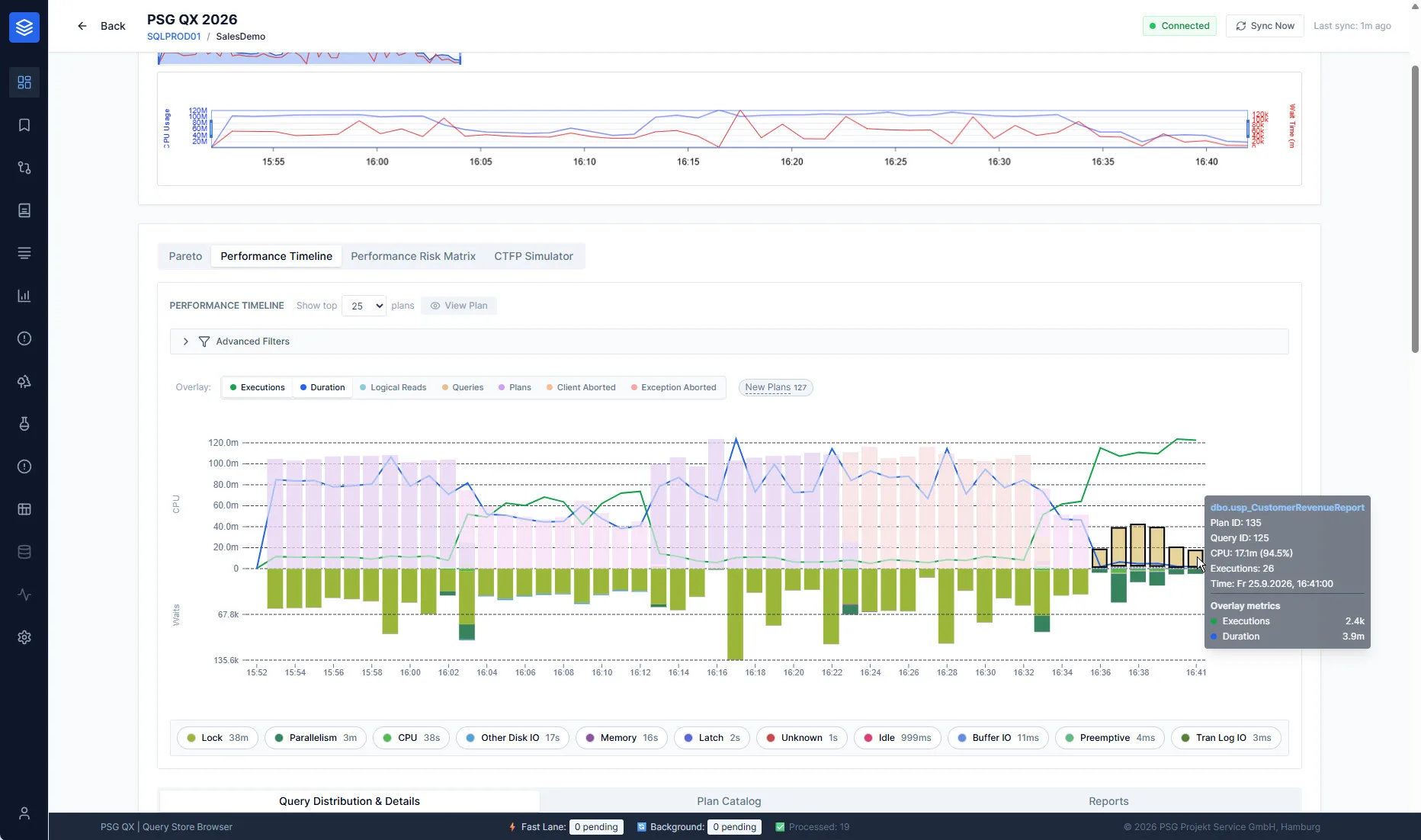
The performance timeline shows CPU, wait times and executions over time and, below that, which plan of which query caused the load.

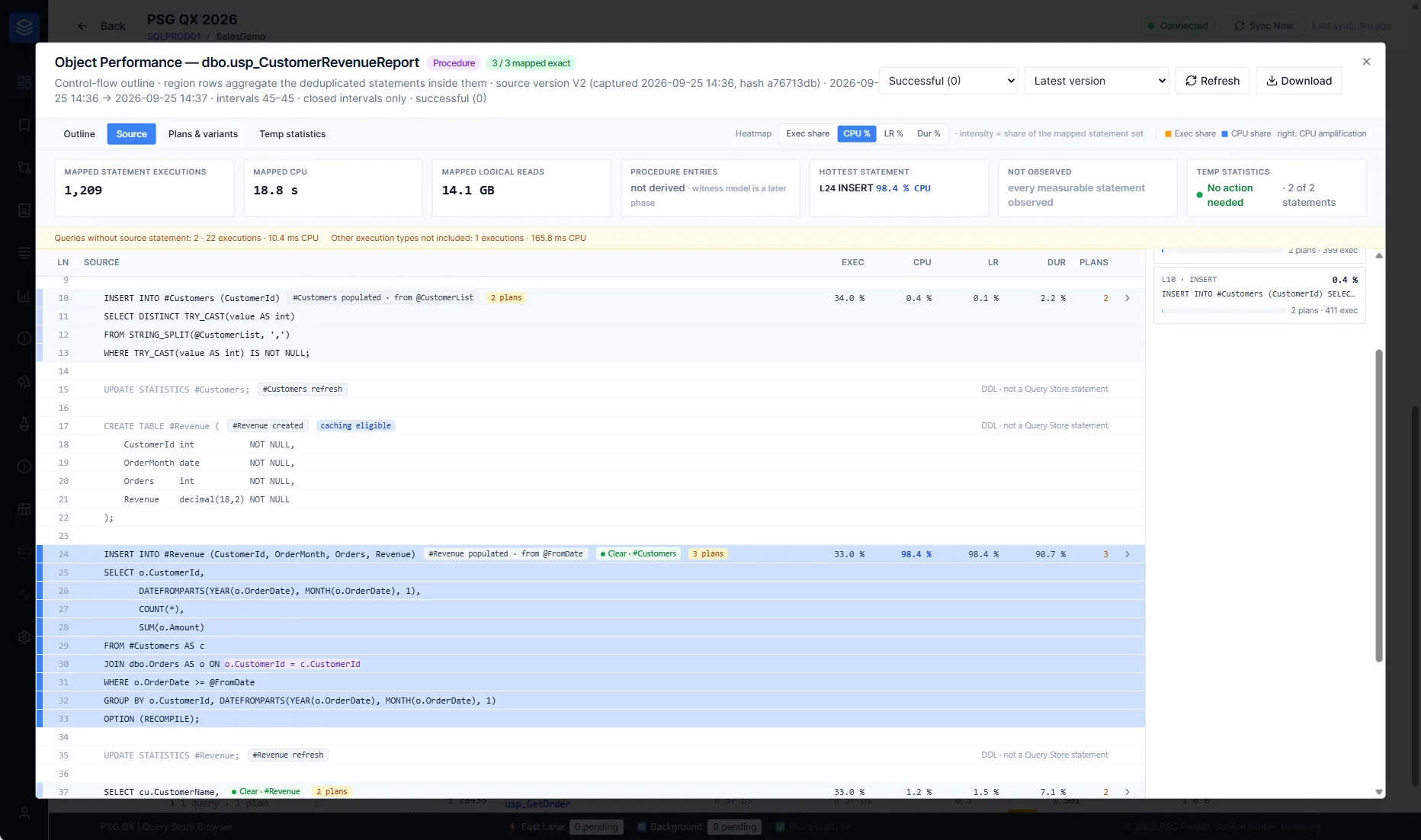
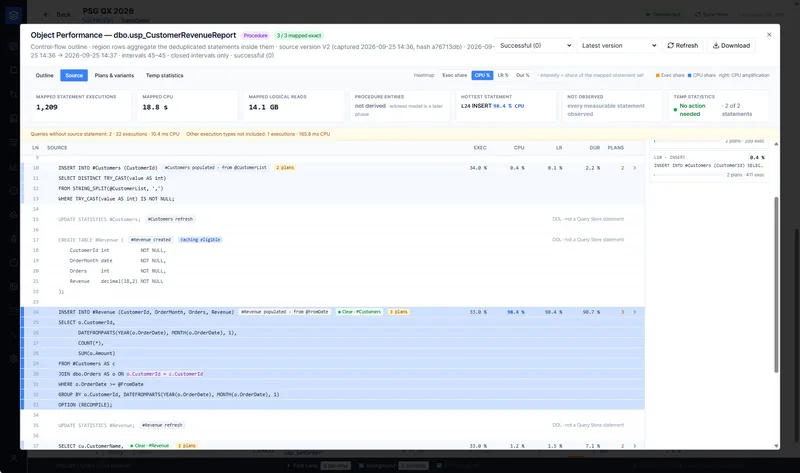
02 · Source code

Which line of code is expensive?

Executions, CPU, reads and duration appear right at the line in the procedure's source code, along with the number of distinct plans.

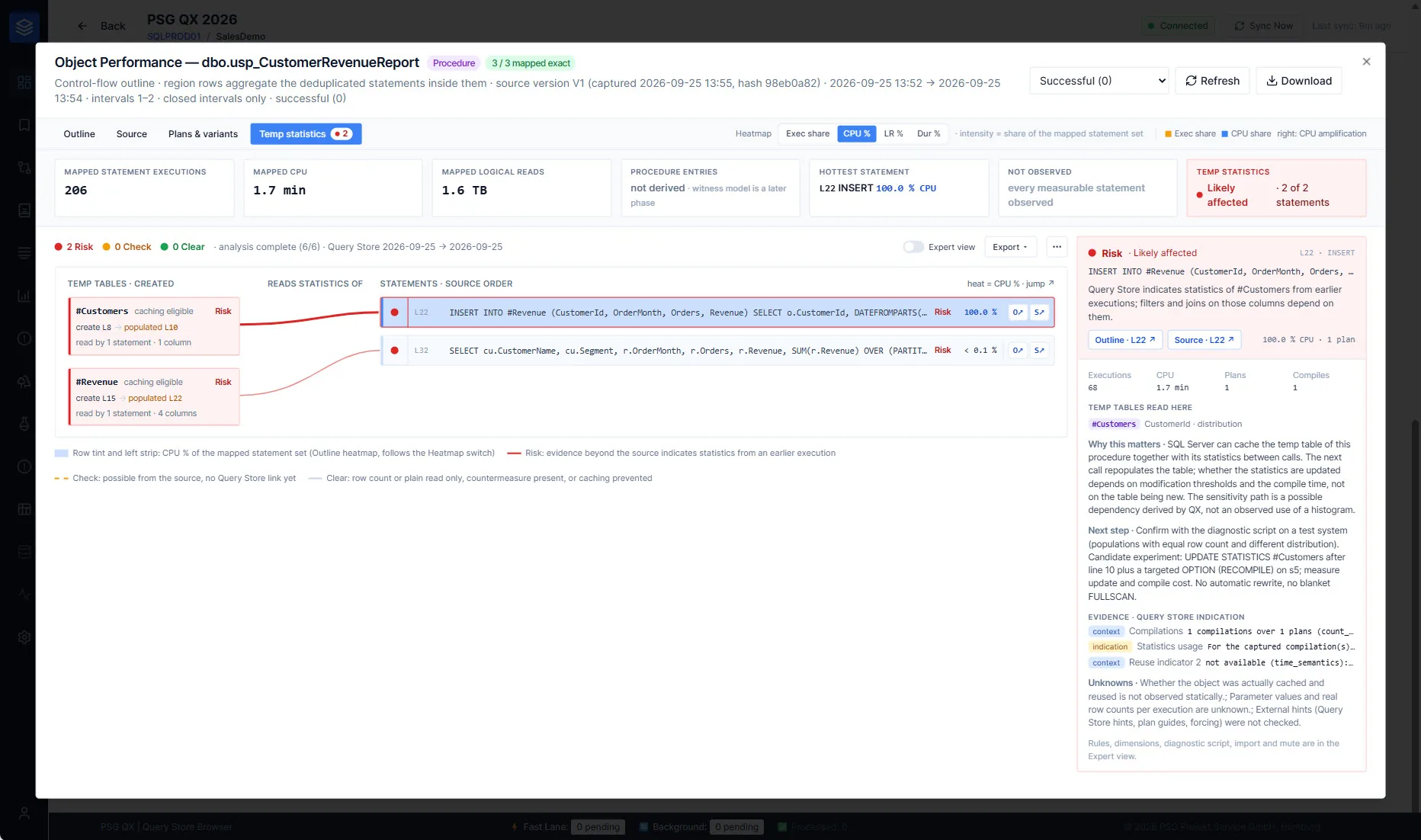
03 · Finding

A finding with evidence, not just an alert.

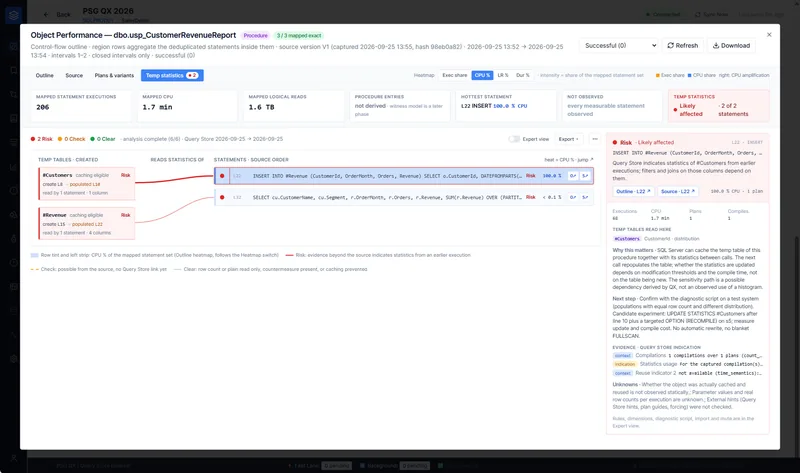
Every finding names its evidence, what is unknown and the next step to check. Here: a risk from cached statistics of a temporary table.

PSG QXClick to enlarge
PSG QX: performance timeline with CPU, wait times and plans PSG QX: source code view with metrics per line of code PSG QX: finding with evidence, unknowns and next step

Prefer to talk right away?

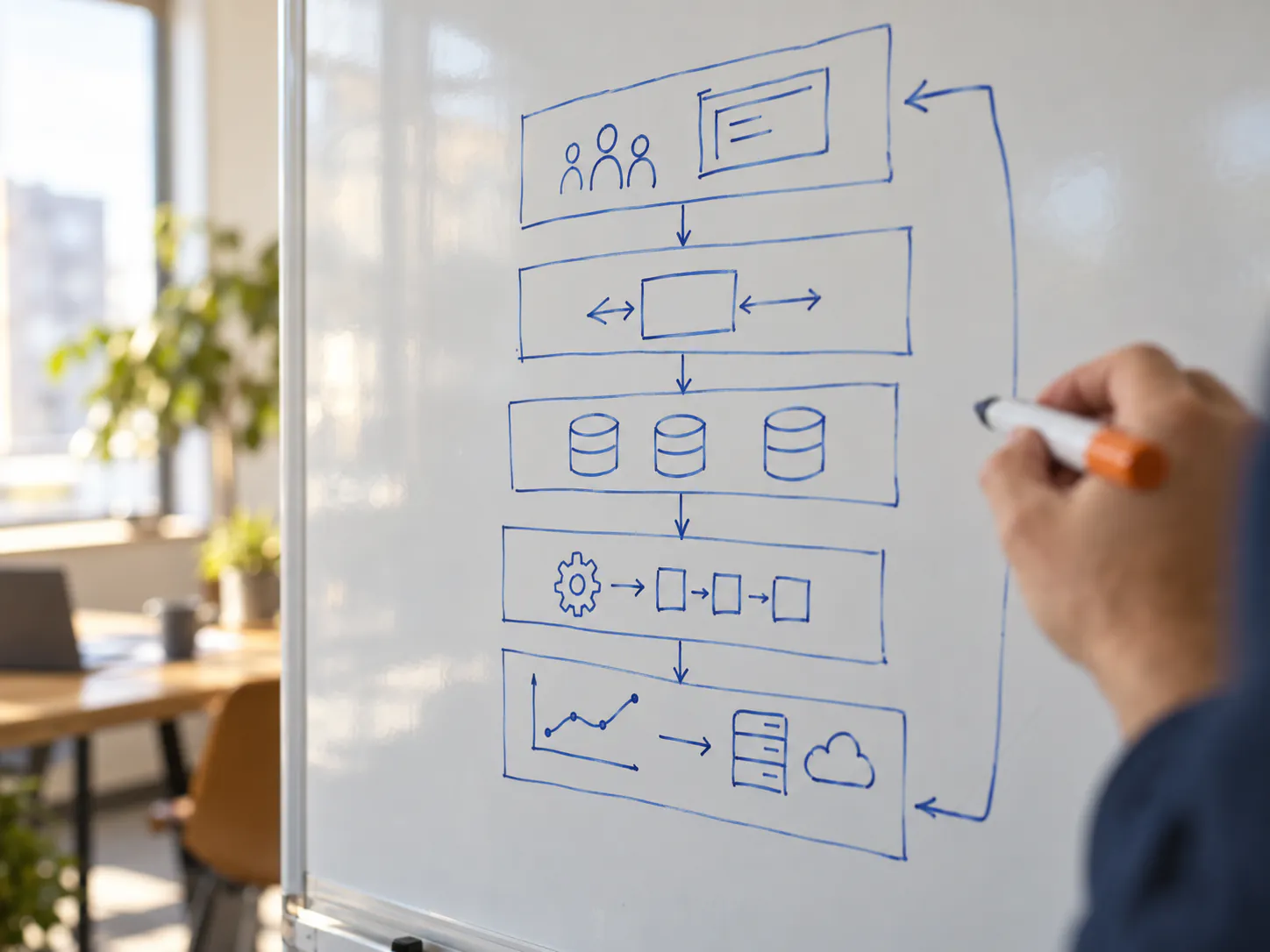
Sketch of a multi-layer system architecture on a whiteboard
How we work

From the question to a verified effect.

Every engagement follows the same pattern, whether a one-time analysis or ongoing support.

  1. 01

    Clarify the question

    What exactly should get better, and how would you notice?

  2. 02

    Choose measurement data

    Collect the data that can actually answer that question.

  3. 03

    Put it in context

    State the finding, evidence, hypothesis and limits openly.

  4. 04

    Agree on measures

    With operations, development and, where applicable, the vendor.

  5. 05

    Verify the effect

    Compare before and after instead of just guessing.

How we analyze

Local.Deterministic.Verifiable.

We have been using data mining for SQL Server analysis for years, long before generative AI and LLMs. Our methods run locally and deterministically: with the same inputs and method versions, every result can be checked again.

finding.txtillustrative example
observation  A central query has been switching between two execution plans since a cutoff date.
evidence     Query Store history: plan changes, run times, affected time windows.
hypothesis   Parameter-dependent plan after a statistics update.
uncertainty  Influence of parallel maintenance jobs not yet ruled out.
measure      Agreed change in a test window.
verification Compare the same metrics before and after the change.

Local

The analysis runs without calling external AI services. Which data flows where, we state specifically for every engagement.

Deterministic

Same inputs, same method version, same result. That keeps every finding repeatable.

Finding with evidence

Every statement names its evidence, its uncertainty and the way to verify it.

Six rules by which we read the history →

Areas of expertise

What we specialize in.

PSG is a consultancy from Hamburg specializing in Microsoft SQL Server. Because we started in 1994 as a software house, we approach every topic as developers: with code, automation and our own tools. These are our areas of expertise, each with what the statement rests on.

SQL Server performance & troubleshooting

Finding causes in queries, plans, wait times and configuration, urgently or in a targeted way.

SQL Server projects since 1998

Query Store & execution plans

Tracing plan changes, regressions and their causes over time.

our own tool: PSG QX

High availability & infrastructure

Always On Availability Groups, failover clusters, disaster recovery, edition and cores.

own infrastructure team, no license sales

Large SQL Server estates

Operations, standardization and maintenance of many servers, generated and automated instead of by hand.

Projects with more than 1,000 servers

In-Memory OLTP

Assessment, migration and operation of memory-optimized tables.

Migrations since 2015

Columnstore indexes for data warehouses

Speeding up analytical queries on large data volumes.

Microsoft Partner Conference 2012

Performance Driven Development methodology

Considering performance in development and architecture from the start.

Trainings and tools since 2016

Performance across many installations

Recognizing patterns across all customer installations of the same software.

QX Fleet for software vendors

Data mining for DBA tasks

Local, deterministic methods for analysis and operations.

In use in PSG QX
Across all layers

Knowledge that stays with the team.

Training, coaching and workshops so that your team understands the connections.

Relaxed training session at a large table, a trainer explaining at the whiteboard
Hands-on, at your pace
Training

Performance Driven
Development

How development, project management and product owners consider performance from the start instead of repairing it later in operations.

Basic modulesAdvanced 1–4Development · PM · PO
Training

PTS
training

Performance Troubleshooting & Support: how SQL Server works internally and how to narrow down bottlenecks systematically.

2 modules of 4 hoursAdmins · DBAs
Coaching

Repository Driven
Design

Designing data access with the repository pattern and clear abstraction so that complexity stays manageable.

2 modules of 4 hoursDevelopment
Coaching

Whiteboard
trainings

Custom formats built around your questions and systems, from a single execution plan to an architecture decision.

customYour team, your systems
Workshop

Workshops
with results

Availability, performance, health check, potential analysis, data warehouse audit or migration: compact, with clear next steps.

AvailabilityPerformanceMigration

For reference, continuously maintained:

Where we work

From Hamburg for Germany, Austria and Switzerland.

We work remotely, through the channels your IT specifies: at short notice and flexibly, even when only an hour on the systems is needed. Same time zone, and we work in German or English, whichever suits your team. And if it really has to be on site, we board a plane.

Map: Germany, Austria and Switzerland, headquartered in Hamburg
About PSG

Started as a software house. Still developers.

PSG was founded in Hamburg in 1994 as a software house. We have been working as consultants for Microsoft SQL Server since 1998. We come primarily from software development, not from administration. That shapes our work to this day: we read the code behind the query, automate what repeats, and build our tools ourselves.

Today, performance engineers and infrastructure colleagues work together in one team: the former investigate what is happening in your systems, the latter plan and build highly available platforms. On the team you will find certifications, talks at professional conferences and a former Microsoft MVP (2014–2016). The PSG Stack is an offering of PSG Projekt Service GmbH.

Think you would fit our team? Write to us at jobs@psg.de.

Hamburg's Inner Alster lake with the town hall at blue hour
1994founded as a software house
1998first SQL Server projects
10+years of the PSG Stack, continuously developed further
Milestones since 1994

Always pushing ahead.

Early with new SQL Server technologies, on big stages and in demanding projects, and with technical articles and talks in the national and international community.

1994Foundingas a software house in Hamburg
1998First SQL Server projects
2005Hamburg SQL Server user groupfounded and organized ever since
2008CeBITSQL Server 2008 presented on the big Microsoft stage
2008 · CeBIT Hannover What did we show?

Among other things, table compression, at the time a brand-new SQL Server 2008 feature. Row and page compression save storage space and often I/O as well, because fewer pages have to be read for the same data.

Live on the big Microsoft stage, in front of the trade fair audience.

2009First RDD projectwith more than 1,000 servers
2009 · Method What is RDD?

Repository Driven Design: structures and logic are described once, declaratively, in a central repository. From that, whatever each target environment needs is generated, instead of maintaining scripts for each server individually.

1,000+servers in the first project, today also offered as training

2012Microsoft Partner ConferenceColumnstore indexes explained on stage in Stuttgart
2012 · SQL Server 2012 What are columnstore indexes?

New with SQL Server 2012: data is stored column by column and highly compressed, and queries process whole blocks of values at once. Analyses over large tables often become many times faster as a result.

Our message to the partners: this makes customers very happy.

2015First In-Memory OLTP migrations
2015 · SQL Server 2014+ What is In-Memory OLTP?

Since SQL Server 2014, tables can reside entirely in memory and procedures can run natively compiled, without locks and latches. With many parallel transactions, this can be a big leap.

Our principle: the load test with your real workload decides, not the demo.

2016First PDD trainings & toolsServer with over 1,000,000 concurrent users
2016 · Method What is PDD?

Performance Driven Development: performance belongs in development and architecture from the start, instead of being repaired later in operations. With continuous measurement, jointly understood expectations, and with project management and product owners at the table.

To the trainings →

2017PSG DBA Pooland the monitoring framework MX
2017 · Operations What is the PSG DBA Pool?

Instead of a single person, a well-coordinated team looks after your SQL Servers: in monthly packages from Bronze to Gold, with regular checks and reachable on business days. MX was added, our monitoring framework, which measures in your environment.

Today's tools MX AIOps and PSG QX come from this line.

2021Predictive monitoring & maintenancefor complex environments
2021 · Monitoring What does predictive mean?

Monitoring that does not only report what has already happened: from the measurement history we read trends and recurring patterns, such as data growth or gradual degradation. That lets you plan maintenance and capacity before things get tight.

Local and deterministic: data mining, long before generative AI.

202430 years of PSGand still pushing ahead
TodayOne team, five layersPerformance, infrastructure, operations and our own tools
Contact

Tell us about your environment.

In the first conversation we clarify whether and how we can help. We reply within 24 hours on business days.

AddressPSG Projekt Service GmbH
Neuer Wall 80, 20354 Hamburg Phone+49 40 39 88 28 75 Emailinfo@psg.de

Are you using PSG QX or MX and need a license?

We arrange license keys, renewals and trial access directly with you.

Request a license